NEWS
WRITING FOR IMPACT: Advancing Sustainable Development through Evidence-Based Narratives
“Enhancing sustainability reporting practices and ensuring that institutional outputs are aligned with both national and global standards”
- Michelle Ann P. Chomayag
- January 20, 2026
- 8:53 pm
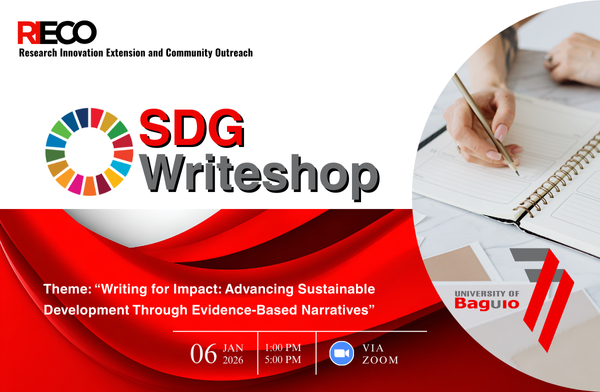
he University of Baguio successfully concluded its SDG Write Shop: Writing for Impact, a capacity-building workshop aimed at strengthening the competencies of faculty members, SDG Leads, and staff in producing evidence-based narratives aligned with the United Nations Sustainable Development Goals (SDGs). Facilitated by the Research, Innovation, Extension, and Community Outreach (RIECO) team, the workshop focused on enhancing sustainability reporting practices and ensuring that institutional outputs are aligned with both national and global standards.
Central to the discussions was the idea that impactful SDG writing goes beyond documenting participation or enumerating activities. Participants were guided to craft structured, evidence-driven narratives that clearly articulate measurable outcomes, sustainability, and alignment with institutional priorities. A systematic framework for SDG articles was introduced, leading participants through key components such as identifying the relevant SDG, defining objectives, establishing institutional alignment, presenting initiatives, documenting evidence and outcomes, demonstrating sustainability, and reflecting on lessons learned.
The Write Shop directly supported SDG 4: Quality Education, particularly its emphasis on inclusive and equitable education and the promotion of lifelong learning opportunities. By equipping educators and staff with skills in evidence-based writing, the activity contributed to Indicator 4.7.1, which measures the integration of global citizenship education and education for sustainable development into institutional practices. Through this write shop, the University strengthened its capacity to document how its programs and initiatives advance education for sustainable development, ensuring that SDG narratives reflect both academic excellence and social responsibility.
Another highlight of the activity was Dr. Michelle Ranges’ emphasis on distinguishing activities from outcomes, reinforcing that meaningful SDG narratives go beyond listing tasks and must clearly demonstrate actual change. She highlighted the need to show sustained impact by embedding initiatives within systems, curricula, policies, or long-term partnerships. She further stressed intentional alignment with the University’s mission and vision, ensuring that SDG engagement remains deliberate and strategic. Moreover, she underscored the value of evidence-based reporting and reflective practice, explaining that acknowledging challenges and lessons learned enhances credibility and positions the University as a meaningful contributor to broader SDG discourse.
Ms. Darimbang and Ms. Chomayag also shared practical insights on writing for platforms such as the THE, SDG Accord, THE Impact Rankings, and the UB SDG Website. They discussed the use of official templates, submission timelines, and evaluation criteria, and emphasized the importance of aligning initiatives with specific SDG targets and indicators. These discussions reinforced the need for precision, documentation, and measurable evidence in sustainability reporting.
In concluding the workshop, the Dr. Donnavila Herbster highlighted key distinctions between SDG Accord case study writing and webpage-based SDG articles, the critical role of SDG 17: Partnerships for the Goals in demonstrating sustainable impact, and the importance of understanding differences between AI and human validation processes. Most notably, she reminded participants that “we are not the champions; the champions are our beneficiaries,” reinforcing the principle that SDG narratives should center on community impact rather than institutional recognition.