RATIONALE
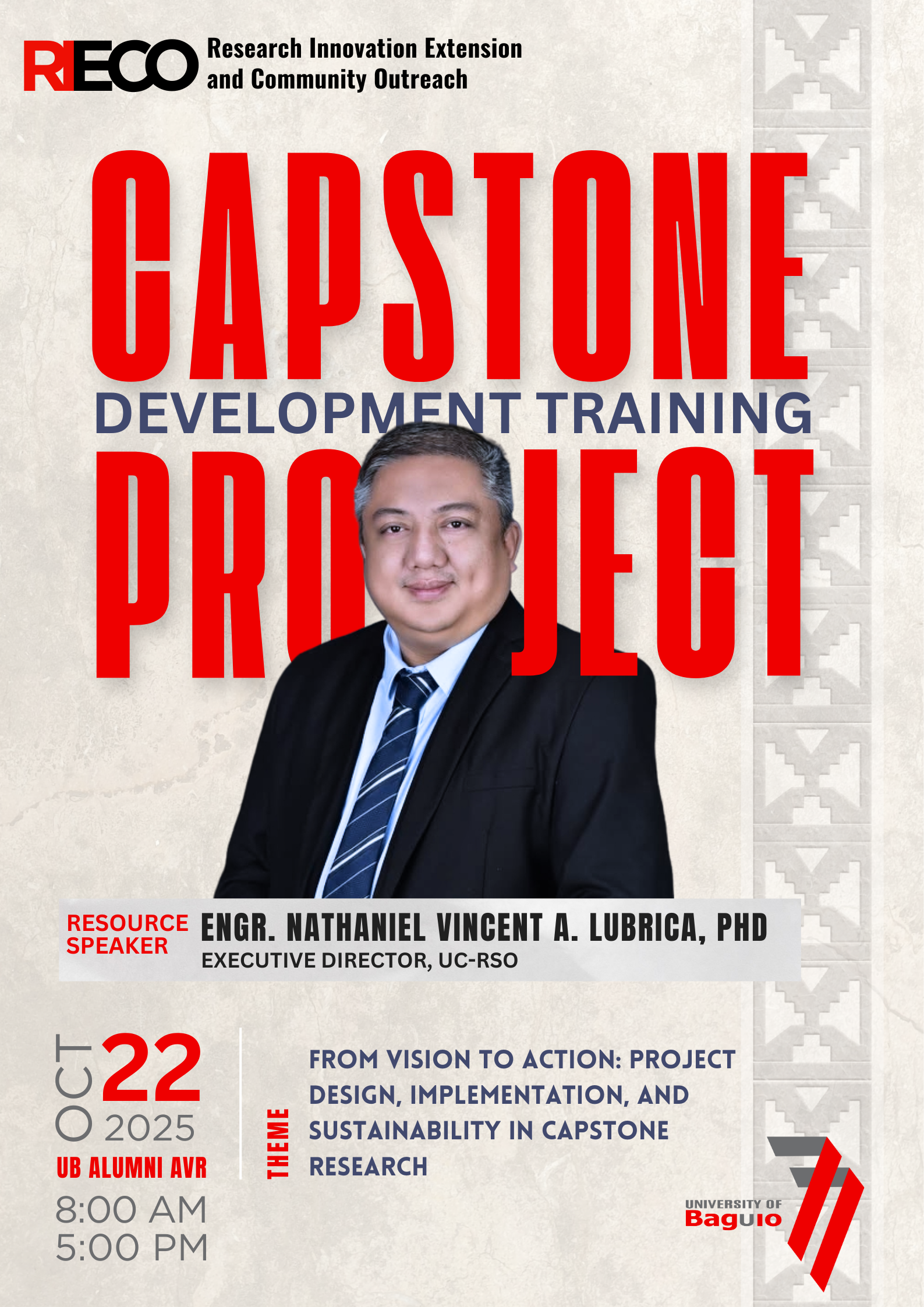 The University of Baguio recognizes the importance of capstone projects as a culminating academic experience that integrates students’ knowledge, skills, and professional competencies across various disciplines. Given the university’s commitment to academic excellence and community impact, as reflected in its diverse programs and leadership initiatives, this two-day Harvard-style training program is designed to enhance the expertise of college instructors in preparing capstone projects. By leveraging proven frameworks and resources from Harvard and other established institutions, the training aims to strengthen instructors’ abilities to design, mentor, and assess capstone projects effectively, thereby enhancing the quality of student outputs and their readiness for real-world challenges.
Moreover, this training aligns with the University of Baguio’s mission to foster innovative, ethical, and socially responsive graduates who contribute meaningfully to their communities. The program’s integration of active learning, peer collaboration, and compliance with research ethics reflects the university’s standards for scholarly rigor and responsible research conduct.
By equipping faculty with advanced skills and practical tools, the University of Baguio ensures sustained improvement in capstone supervision that supports diverse student needs and project complexities. This initiative not only reinforces the institution’s reputation for academic leadership but also promotes a culture of continuous professional development among its educators.
OVERALL TRAINING OBJECTIVES
The training objectives for the two-day comprehensive capstone project preparation program are:
- Understand the influence of Systems and Design Thinking in the Capstone project conceptualization.
- Align capstone projects with program learning outcomes and institutional goals to ensure academic rigor and relevance to real-world challenges.
- Equip instructors with skills to design, scaffold, and mentor capstone projects effectively, using evidence-based frameworks and best practices from Harvard and peer institutions.
- Strengthen understanding and compliance with ethical research standards and IRB protocols to safeguard academic integrity and responsible project conduct.
- Foster collaborative peer learning and crisis management skills to support diverse student needs and address common challenges in capstone project implementation.
- Guide trainees to develop their own capstone project as a practical output of the training, reinforcing their mastery of design, implementation, and assessment principles. This ensures that participants not only gain theoretical knowledge but also apply it by creating a tangible capstone project prototype, which aligns with best practices emphasizing hands-on, integrative learning experiences crucial for effective capstone supervision
These objectives reflect the University of Baguio’s commitment to academic excellence, ethical scholarship, and the professional development of its faculty, aligning with its mission to produce graduates capable of meaningful community impact.
Day 1: Foundations of Capstone Project Preparation
Training Objectives:
- Understand Systems and Design Thinking as Tools for Transformative Problem-Solving
- Understand the role and significance of capstone projects in higher education, aligned with the University of Baguio’s academic standards.
- Learn to design capstone projects that integrate interdisciplinary knowledge and address real-world problems relevant to the Philippine context.
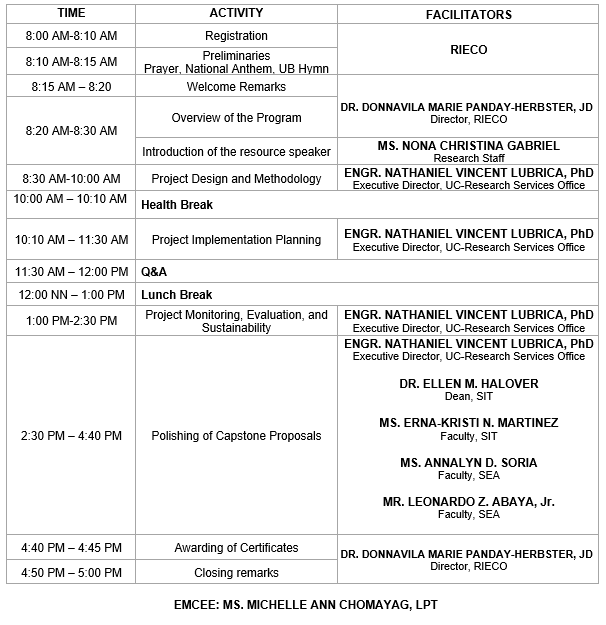
Schedule & Activities:
 Engr. Nathaniel Vincent Lubrica currently serves as the Executive Director of the Research Services Office at the University of the Cordilleras, where he has been a committed academic leader and researcher for over nineteen years. He is also an Associate Professor, teaching courses in mathematics, statistics, and technology, and has previously served as Director of the Research and Innovation Office and Officer-in-Charge of the Research and Development Center. His leadership has been instrumental in fostering a strong research culture and innovation ecosystem within the university.
Aside from his academic endeavors, Engr. Lubrica is a Civil-Structural Engineer and Environmental Planner at Lubrica, Sons, and Associates, with more than twenty-two years of professional experience in civil engineering design, project management, and environmental planning. He is also a review lecturer at RAM Review and Design, specializing in timber, steel, and concrete design, as well as earthquake engineering and the National Structural Code of the Philippines.
He earned his Doctor of Philosophy in Rural Development from Benguet State University, a Master’s in Environmental and Habitat Planning, and a Bachelor’s in Civil Engineering (Cum Laude) from Saint Louis University.
Engr. Lubrica has also led several nationally funded research projects such as Program BOONDOCK – the Mountain Engineering Research and Development Center, Project CALAMI-T, and Project DANUM, which focuses on sustainable infrastructure, disaster resilience, and environmental management. His research has earned multiple recognitions from the Department of Science and Technology (DOST), including First Place in Creative Research in regional and national invention contests, and a Plaque of Recognition from the Department of the Interior and Local Government for his contributions to community-based innovation and development.